Is Agile Marketing just digital hype, or a practical strategy for success in the digital age?
Agile Marketing: Digital Marketing Hype or Practical Strategy for Success in the Digital Age?
Imagine the world of marketing as a vast puzzle, where each piece represents a strategy to connect with customers and navigate the ever-changing digital landscape. Traditionally, marketing followed a rigid plan, akin to following a recipe to bake cookies. But then, a remarkable transformation unfolded in the early 2010s, akin to the arrival of a new superhero in the marketing realm – Agile Marketing.
Now, you may be curious, “What exactly is Agile Marketing, and why does it resemble a superhero?” In this article, we’ll embark on a journey delving into the history, principles, advantages, common misconceptions, frameworks, and real-world instances of Agile Marketing. We’ll uncover how this dynamic approach is reshaping the way businesses engage with customers, adapt to market trends, and evolve their strategies in the ever-evolving digital landscape.
Table of Contents
1. What is Agile Marketing?
Imagine you’re in your kitchen, ready to bake some cookies. You carefully follow a recipe step by step, ensuring that every ingredient is added in just the right amount. This meticulous approach is quite reminiscent of how traditional marketing used to operate — a fixed plan that was challenging to alter once set in motion.
Now, let’s fast forward to the early 2010s. During this period, individuals proficient in creating computer software, such as apps and games, stumbled upon something truly revolutionary. Instead of adhering to rigid plans, they embraced a more flexible and adaptable way of working, much like superheroes who can swiftly adjust their strategies as the situation demands. They aptly coined this dynamic approach “Agile.”
Defining Agile
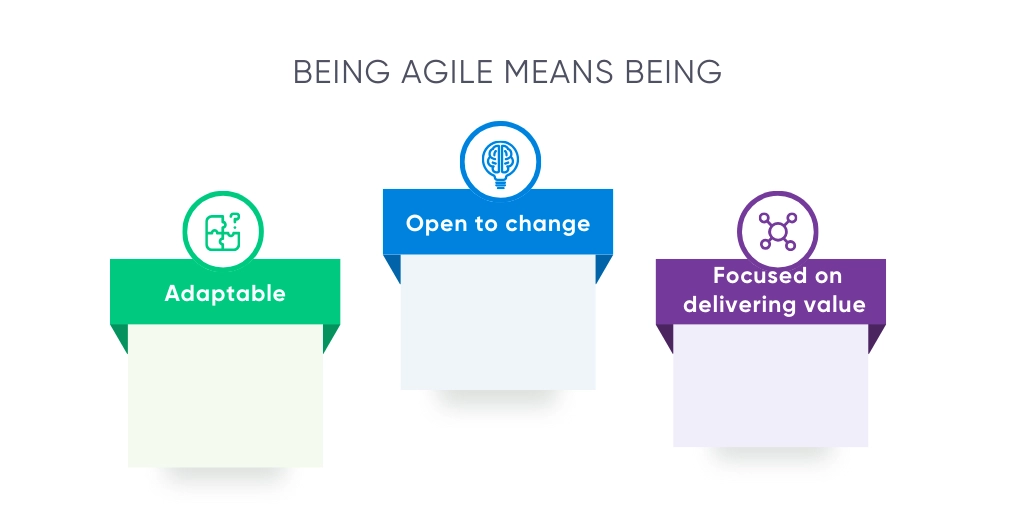
Before we delve deeper into Agile Marketing, let’s define the term “Agile.” Agile is a mindset and a set of principles that originated in the realm of software development. It emphasizes collaboration, customer feedback, and the ability to respond to change quickly. In essence, being Agile means being adaptable, open to change, and focused on delivering value to the end-user.
Now, here’s where things get particularly intriguing for the world of marketing. Forward-thinking individuals had a groundbreaking idea: “If Agile methodologies work wonders in software development, could they also transform our marketing efforts?” With this notion in mind, they embarked on applying Agile principles to marketing, giving birth to what we now know as Agile Marketing.
Agile Marketing is all about flexibility, adaptability, and the ability to make quick adjustments in response to changing market conditions and customer preferences.
The emergence of Agile Marketing
The rise of Agile Marketing began in the early 2010s, much like the arrival of a new superhero on the marketing scene. While its ascent wasn’t instantaneous, it swiftly gained popularity. This period marked a realization that, in our fast-evolving world, marketing needed to emulate the traits of a superhero—nimble, adaptable, and capable of aligning with evolving consumer preferences.
Imagine this scenario: just as you might adjust your cookie recipe midway through if you realize you need more chocolate chips, Agile Marketing empowers marketers to tweak their strategies on the fly, guided by the ever-changing preferences of their audience. It’s all about being swift and astute in a landscape where shifts occur in the blink of an eye.
Agile Marketing emerged as ingenious marketers borrowed concepts from Agile software development superheroes to infuse marketing with flexibility and effectiveness. Since then, it has proven invaluable in helping businesses stay attuned to the lightning-paced digital world.
2. Unveiling the Power of Agile Marketing
Imagine you’re a superhero, and your mission is to save the day. You need a strategy that lets you adapt quickly to unexpected changes, work with your superhero team seamlessly, and always keep your focus on what the people you’re saving need. Well, that’s kind of like what Agile Marketing does for businesses in the real world.
TOP 8 Agile Marketing Principles
Let`s dive into the heart of Agile Marketing—the key principles that make it tick. These principles are like the guiding stars that keep Agile Marketing on course, ensuring its success in the ever-changing marketing galaxy. Let’s explore these principles and see how they can revolutionize your marketing strategies, making them more adaptable, customer-centric, and effective.
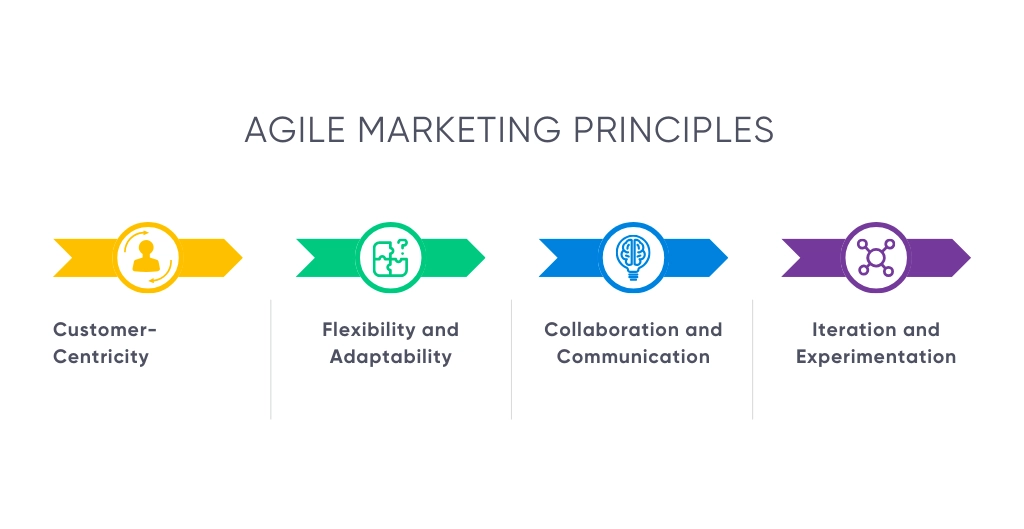
1. Customer-Centricity: Putting the Audience First
In Agile Marketing, the customer is the North Star. Everything revolves around understanding their needs, desires, and preferences. By aligning your marketing efforts with what your audience values most, you create campaigns that resonate deeply and build lasting connections.
2. Flexibility and Adaptability: Embracing Change
Change is a constant in the world of marketing. Agile Marketing encourages flexibility and the ability to pivot when needed. Instead of sticking rigidly to a plan, teams can adjust their strategies based on real-time data and evolving market conditions.
3. Collaboration and Communication: The Power of Teamwork
Agile Marketing thrives on collaboration. Teams work closely together, breaking down silos and sharing insights. Clear and open communication is the key to success, ensuring everyone is on the same page and working towards common goals.
4. Iteration and Experimentation: Learning from Every Step
Agile Marketing believes in learning through action. Instead of aiming for a perfect, one-shot campaign, teams launch smaller experiments. They gather data, analyze results, and refine their approach continuously, resulting in more effective strategies over time.
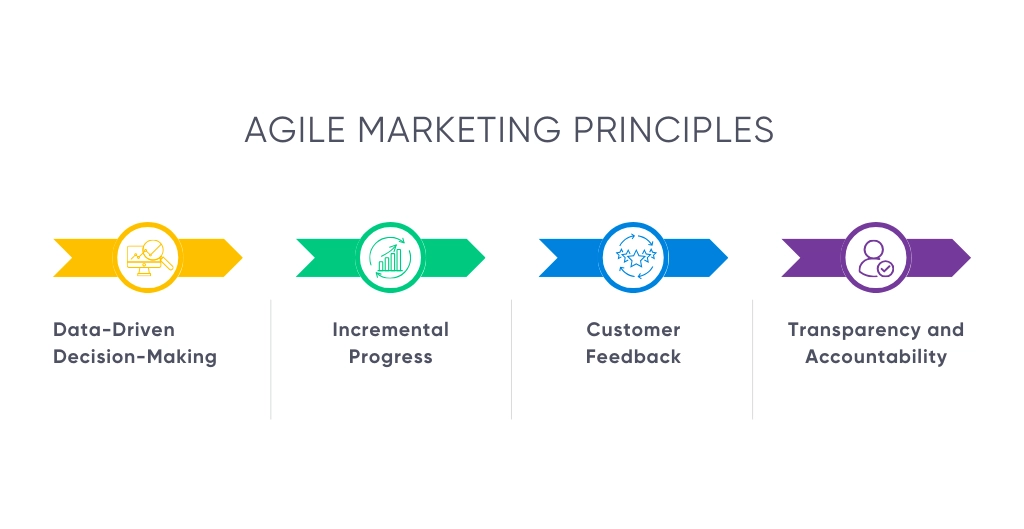
5. Data-Driven Decision-Making: Letting Numbers Guide You
Data is the compass in Agile Marketing. Marketers rely on data and analytics to make informed decisions. It’s not about guesswork; it’s about using real data to steer your marketing ship in the right direction.
6. Incremental Progress: Building Step by Step
Agile Marketing promotes incremental progress. Instead of aiming for a giant leap, teams make small, frequent advancements. This approach allows for quicker wins and more adaptability along the way.
7. Customer Feedback: A Constant Guide
Listening to what your customers have to say is crucial in Agile Marketing. Their feedback guides improvements and helps ensure your strategies align with their preferences.
8. Transparency and Accountability: Owning Your Actions
Accountability is a cornerstone of Agile Marketing. Teams take responsibility for their tasks, and transparency ensures everyone knows what’s happening. This fosters trust and ensures that everyone is working towards a common goal.
In the world of Agile Marketing, these principles act as the guiding constellations in the marketing sky. They create a framework that allows marketers to adapt, innovate, and thrive in a rapidly changing environment.
Who Can Benefit from Agile Marketing?
Agile Marketing isn’t some mysterious code only known to a secret few. It’s a dynamic approach available to anyone, be it businesses, teams, or individuals from diverse backgrounds. The beauty of Agile Marketing lies in its inclusivity, catering to a broad spectrum of needs. Let’s dive deeper into who precisely can tap into the captivating realm of Agile Marketing and elevate their marketing endeavors.
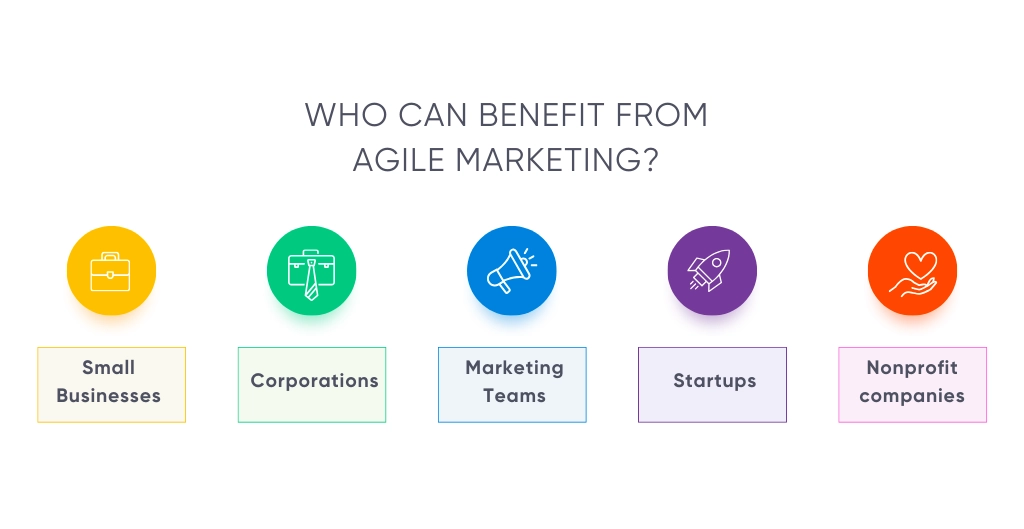
Small Businesses
Imagine you’re a small business owner, navigating a vast ocean filled with larger, more established competitors. Agile Marketing can be your trusty compass, guiding you to compete and grow swiftly. With its adaptable strategies, you can seize opportunities and make waves in your industry.
Big Corporations
Even colossal corporations can harness the power of Agile Marketing. It’s like giving a giant the agility of a nimble acrobat. Agile Marketing injects flexibility and customer-centricity into large organizations, enabling them to pivot swiftly and stay in tune with the ever-changing market.
Marketing Teams
For marketing professionals working in dynamic environments, Agile Marketing is a breath of fresh air. It’s akin to adding rocket boosters to your creativity and effectiveness. Agile methodologies foster collaboration, streamline workflows, and make every day on the job more exciting and productive.
Startups
Startups are like explorers setting off on uncharted paths. Agile Marketing serves as their treasure map, allowing them to experiment and discover the most effective ways to reach their audience. It’s about adaptability, learning, and achieving growth in the early stages of the journey.
Nonprofit organizations
Organizations dedicated to making the world a better place can wield Agile Marketing as their cape of impact. Agile strategies help nonprofits spread their message far and wide, connecting with more people and communities to create positive change.
Agile Marketing is your gateway to a more adaptable, customer-focused, and successful marketing journey.
Agile Marketing is akin to a superpower for marketing. It accelerates progress, fosters flexibility, and places the customer at the heart of every strategy. Whether you’re a small business owner, a corporate giant, a marketing professional, a startup trailblazer, or a nonprofit on a mission, Agile Marketing is a tool worth exploring. It’s your gateway to a more adaptable, customer-focused, and successful marketing journey.
3. Agile Marketing Frameworks: Scrum, Kanban, and Scrumban
We’ve been on an exciting journey through Agile Marketing, uncovering its benefits, the diverse beneficiaries, and its guiding principles. Now, let’s venture into the world of Agile Marketing frameworks—a bit like the tools and blueprints that help bring marketing strategies to life. We’ll explore three key frameworks—Scrum, Kanban, and Scrumban—so everyone, can grasp how they support autonomous work.
Scrum: The Agile Game of Tasks
Imagine you’re part of a team working on a big puzzle, but instead of completing it all at once, you break it into smaller, manageable pieces. That’s what Scrum does for marketing teams. It turns work into a fun game with clear rules.
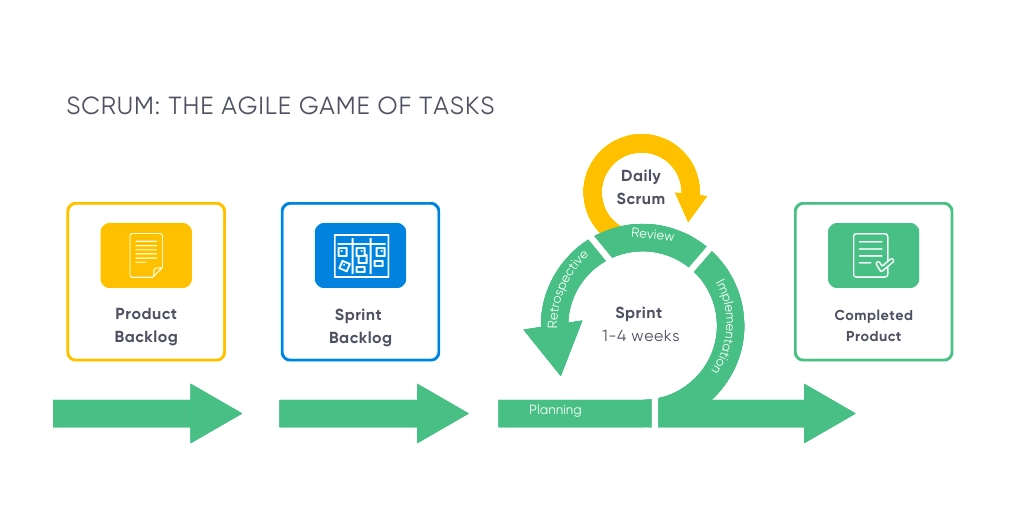
The puzzle pieces, in this case, are tasks, and Scrum divides them into “sprints.” Think of sprints as short races to complete tasks. Each sprint has a specific goal, and your team works together to finish it. When a sprint ends, it’s like reaching a level in a video game—you celebrate your achievements!
Scrum encourages teamwork, focus, and regular check-ins to make sure everything stays on track. It’s a fantastic framework for Agile Marketing because it keeps everyone on the same page and moving forward.
Kanban: The Visual Task Board
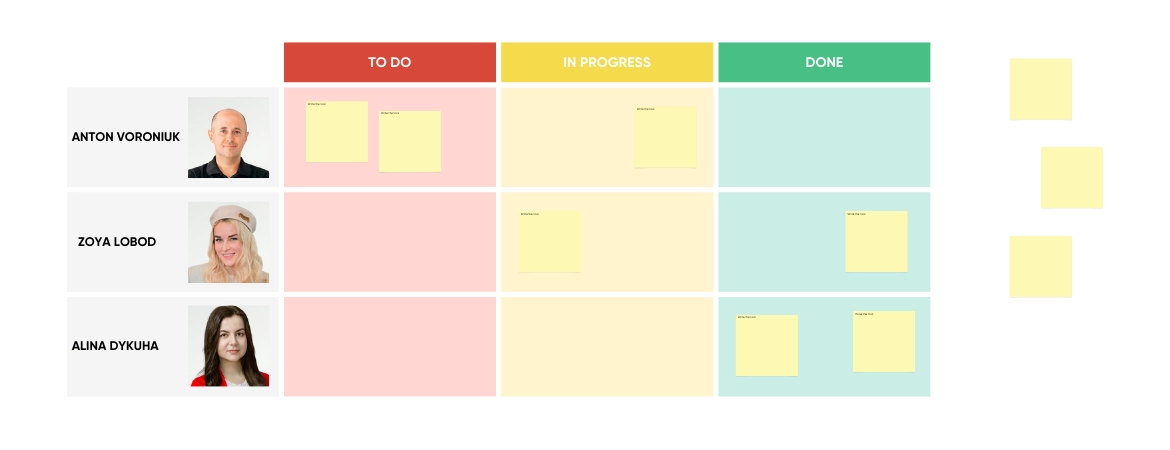
Now, picture a large board covered in colorful sticky notes. Each sticky note represents a task, and they’re organized into columns. As you work on a task, you move its sticky note from one column to the next.
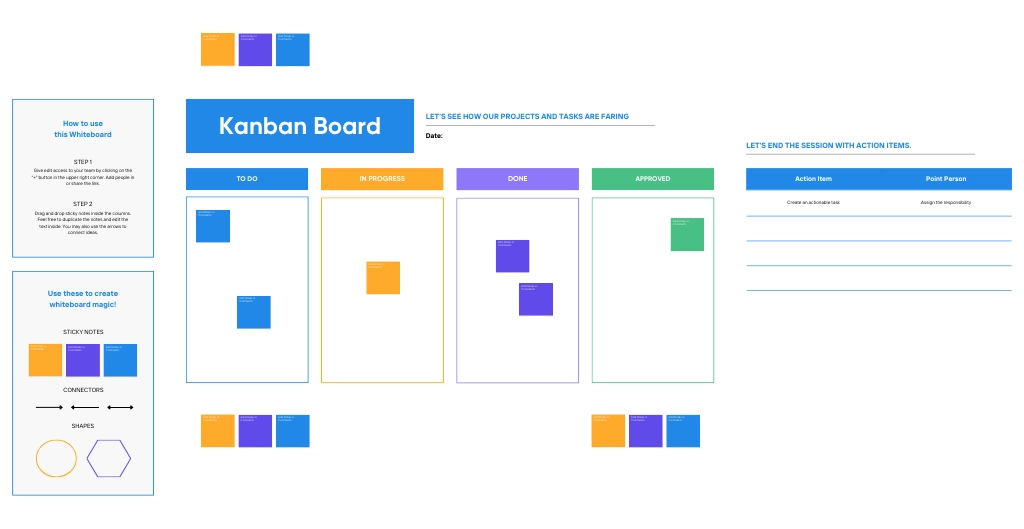
Kanban is a bit like a visual to-do list, but way more fun! It helps teams stay organized by giving them a clear picture of what needs to be done, what’s in progress, and what’s finished. Kanban is like a dance, where tasks move gracefully from “To-Do” to “Doing” and finally to “Done.” It’s perfect for teams that want a clear visual of their work and need to avoid getting overwhelmed.
Scrumban: A Perfect Blend
Let’s imagine mixing your favorite ice cream flavors to create a unique blend. That’s what Scrumban does with Scrum and Kanban. It combines the best of both worlds. You get the structure of Scrum’s sprints, like focused teamwork during a game, but you also have the adaptability of Kanban’s visual flow, like the flexibility of your favorite to-do list.

Scrumban is like having a plan with room for adjustments. It’s ideal for teams that want a bit of structure but also value the freedom to adapt to changing situations.
These frameworks offer organized ways to manage work, promote teamwork, and keep marketing projects on track. These frameworks are making Agile Marketing accessible and effective for everyone, whether you’re a marketing pro or just starting your journey!
4. Demystifying Common Agile Marketing Myths: Separating Fact from Fiction
Agile Marketing has emerged as a game-changer in the dynamic world of marketing. Its principles of flexibility, adaptability, and customer-centricity have transformed how marketing teams operate. However, like any popular approach, Agile Marketing has its fair share of myths and misconceptions. Let’s uncover these myths and set the record straight.
Myth 1: Agile Marketing is Only for Tech Companies
Fact: While Agile methodologies did originate in the tech world, Agile Marketing is not limited to tech companies. It’s a versatile approach that can benefit businesses across various industries. Whether you’re in retail, healthcare, finance, or any other sector, Agile Marketing can help you respond to market changes, customer needs, and emerging trends effectively.
Myth 2: Agile Marketing Means No Planning
Fact: Agile Marketing isn’t about abandoning planning. It’s about adapting your plans as you go. While Agile embraces change, it still requires initial planning to set goals, identify priorities, and create a roadmap. The difference is that Agile planning is more flexible, allowing teams to adjust their strategies based on real-time data and insights.
Myth 3: Agile Means Chaotic Work
Fact: Agile Marketing promotes structure and organization. Teams follow specific methodologies like Scrum or Kanban, which provide clear guidelines for how work is planned, executed, and tracked. This structure ensures that everyone knows their roles, tasks, and responsibilities, reducing chaos and improving productivity.
Myth 4: Agile Marketing is All About Speed
Fact: While Agile does emphasize delivering value quickly, speed is not the only focus. Quality is equally important. Agile teams prioritize delivering high-quality work that meets customer needs. It’s about finding the right balance between speed and quality to create impactful marketing campaigns.
Myth 5: Agile Marketing is Just for Large Teams
Fact: Agile Marketing principles can benefit teams of all sizes. While larger teams may implement Agile at scale, smaller teams can also adopt Agile practices tailored to their needs. In fact, Agile is often more accessible to smaller teams due to their agility in decision-making and execution.
Myth 6: Agile Means Endless Changes
Fact: Agile doesn’t mean constant pivoting without direction. Agile teams work in defined timeframes called sprints, during which changes are made based on data and feedback. However, Agile also provides stability by setting clear sprint goals and long-term objectives.
Myth 7: Agile Marketing is Only for Campaigns
Fact: Agile Marketing is not limited to campaign management. It can be applied to various marketing functions, including content creation, social media management, SEO, and more. Any aspect of marketing that benefits from flexibility and adaptability can benefit from Agile principles.
Myth 8: Agile Marketing Doesn’t Require Documentation
Fact: While Agile promotes face-to-face communication, documentation is still essential. Agile teams often use user stories, backlogs, and sprint planning documents to maintain clarity, track progress, and ensure everyone is on the same page.
Myth 9: Agile Marketing Doesn’t Need Marketing Analytics
Fact: Agile Marketing relies on data-driven decision-making. Marketing analytics play a crucial role in understanding customer behavior, campaign performance, and market trends. Agile teams use data to make informed decisions and continuously improve their strategies.
Myth 10: Agile Marketing is a One-Size-Fits-All Solution
Fact: Agile Marketing is adaptable, and teams can tailor it to their specific needs. There’s no one-size-fits-all approach. Teams can choose from different Agile methodologies and adapt them to suit their unique circumstances.
Agile Marketing is a powerful and flexible approach that can benefit businesses of all sizes and industries. By dispelling these common myths, we hope to provide a clearer understanding of Agile Marketing’s principles and how they can be applied effectively to drive marketing success.
5. Agile Marketing in Action: Real-Life Digital World Examples
In the fast-paced realm of digital marketing, agility isn’t just an advantage—it’s a necessity. Imagine marketing as a race, and in this race, Agile Marketing is the sprinter, always ready to adapt and surge ahead. To help you grasp the power of Agile Marketing, let’s explore real-life examples from the digital world where it has made a significant impact.
HubSpot: Inbound Marketing Mastery
HubSpot, a leading inbound marketing platform, is a shining example of Agile Marketing in action.
They embrace Agile principles to continuously refine their marketing strategies. HubSpot’s teams work in sprints, allowing them to pivot swiftly when they spot trends or gather new data. This adaptability has catapulted them to the forefront of the digital marketing industry.
Spotify: Personalized Playlists with Data Magic
Spotify, the music streaming giant, thrives on Agile Marketing to create personalized playlists for its users.

They use data analytics to track user preferences in real time. Based on your listening habits, they quickly curate playlists like “Discover Weekly.” Agile methods enable them to refine these playlists, keeping users engaged and delighted.
Airbnb: Hyper-Localized Experiences
Airbnb, the global travel platform, relies on Agile Marketing to provide hyper-localized experiences to its users.

They constantly analyze data to understand what travelers are looking for in specific locations. Agile Marketing allows them to adapt their recommendations and marketing messages for each destination, ensuring relevance and customer satisfaction.
Netflix: Data-Driven Content Creation
Netflix, the streaming giant, is a master of Agile Marketing. They use data to guide content creation and recommendation algorithms.
When they notice a surge in interest in a particular genre or theme, they quickly adapt by producing or promoting related content. This agile approach keeps viewers engaged and satisfied.
Coca-Cola: Agile Campaigns with a Twist
Coca-Cola, a global beverage powerhouse, applies Agile Marketing to its campaigns. They famously launched the “Share a Coke” campaign, which involved personalizing bottles with names.

When they saw the campaign’s immense success, they quickly adapted it to various countries, featuring culturally relevant names and phrases. This agility helped them connect with diverse audiences worldwide.
Oreo: Timely Social Media Savvy
Oreo, the cookie company, showcased Agile Marketing brilliance during the 2013 Super Bowl blackout. In a matter of minutes, they posted a tweet saying, “You can still dunk in the dark.”
This timely and witty response went viral, demonstrating the power of being agile on social media and seizing opportunities as they arise.
These real-world examples illustrate how Agile Marketing isn’t just a theory. It’s a game-changing strategy embraced by some of the world’s most successful digital players. In a landscape where change is the only constant, Agile Marketing equips businesses to pivot, adapt, and stay ahead of the curve.
Whether you’re a digital marketing enthusiast or a business owner looking to thrive in the digital realm, these examples highlight the transformative potential of Agile Marketing in the real world.
6. Embarking on Your Agile Marketing Learning Path
In today’s fast-paced digital landscape, marketing is no longer just about traditional campaigns and fixed strategies. To stay competitive, marketing professionals need to embrace change, adapt quickly, and align with customer needs. This is where Agile Marketing comes into play. If you’re eager to embark on your Agile Marketing learning journey, you’ve come to the right place.
How to Start Your Agile Marketing Learning Journey?

STEP 1. Join online courses and get certifications
There are numerous online courses and certifications that cover Agile Marketing principles, methodologies, and best practices. These courses provide structured learning materials, and hands-on exercises, and often include assessments to test your knowledge.
Join the “Implementing Agile Marketing and Marketing Sprints” Course
This course is designed to equip you with the knowledge, skills, and tools you need to thrive in the ever-evolving world of Agile Marketing.

What you’ll learn in this Agile Marketing Course
- Master Agile Marketing
- Unlock the Potential of Agile Practices
- Build an Agile Marketing Team
- Implement Agile Marketing in Your Company
- Utilize Tools for Agile Marketing
- Define Marketing Objectives and Goals
- Run Successful Marketing Sprints
- Measure and Evaluate Marketing Success
Why choose this Agile Marketing course
- Real-World Expertise
- Practical Solutions for Real-World Challenges
- Interactive and Engaging Learning
- Flexibility and Convenience
- Lifetime Access and Updates
- Certificate of Completion
Are you ready to transform your marketing team’s effectiveness and become an influential leader who drives exceptional results?
Click the “Enroll now” button and start your course today! Boost your marketing team’s effectiveness, elevate your leadership skills, and unlock your marketing potential. Your Agile Marketing adventure begins here.
STEP 2. Read books dedicated to Agile Marketing
Many experts have written books and maintained blogs dedicated to Agile Marketing. These resources offer in-depth insights, real-world examples, and practical tips for implementing Agile in your marketing efforts.

Here are some highly recommended books about Agile Marketing.
“Killing Marketing: How Innovative Businesses Are Turning Marketing Cost into Profit” by Joe Pulizzi and Robert Rose
This book explores the transformation of marketing into a profit center through Agile methodologies. It provides insights on how to rethink traditional marketing strategies and adapt to the changing digital landscape.
“Lean Branding: Creating Dynamic Brands to Generate Conversion” by Laura Busche
The book offers practical advice on building and evolving your brand in a dynamic environment.
“The Agile Marketer: Turning Customer Experience Into Your Competitive Advantage” by Roland Smart
Roland Smart explores how Agile principles can be applied to marketing, helping teams adapt to changing customer needs and deliver a better customer experience.
“Agile Estimating and Planning” by Mike Cohn
Although this book primarily focuses on Agile project management and software development, its concepts and techniques can be adapted to Agile marketing projects, especially when it comes to estimating and planning.
“Agile Marketing: Building Endurance for Your Content Marketing Team” by Jeff Julian and Andrea Fryrear
This book provides a comprehensive guide to implementing Agile marketing in your organization. It covers Agile methodologies, team collaboration, and practical tips for marketers.
“Scrum: The Art of Doing Twice the Work in Half the Time” by Jeff Sutherland
While not a marketing-specific book, this book introduces the Scrum framework, which is commonly used in Agile marketing. It’s valuable for understanding the principles behind Scrum and how they can be applied to marketing.
“Lean Enterprise: How High-Performance Organizations Innovate at Scale” by Jez Humble, Joanne Molesky, and Barry O’Reilly
This book explores Lean principles in the context of large organizations but includes insights that can be applied to Agile marketing at scale.
STEP 3. Attend workshops and webinars

Attend workshops, webinars, and seminars hosted by Agile Marketing experts and organizations. These interactive sessions often include:
- Live demonstrations
- Q&A sessions
- Opportunities for networking with fellow learners.
STEP 4. Join online communities

Join online communities and forums dedicated to Agile Marketing. These platforms allow you to:
- Connect with like-minded professionals
- Ask questions
- Share experiences and knowledge
STEP 5. Create your Agile Marketing toolbox
As you embark on your Agile Marketing learning path, consider building a toolbox of essential skills and knowledge.

1. Understanding Agile Principles
Start with a solid understanding of Agile principles and values. These form the foundation of Agile Marketing and guide your approach to marketing strategies.
2. Agile Methodologies
Dive deep into Agile methodologies like Scrum, Kanban, and Scrumban. Learn how to implement these frameworks and tailor them to your marketing projects.
3. Collaboration and Communication
Enhance your collaboration and communication skills. Agile Marketing thrives on open communication and teamwork.
4. Data Analysis
Develop proficiency in data analysis and interpretation. Learn how to gather, analyze, and leverage data to make informed marketing decisions.
5. Tools and Software
Familiarize yourself with Agile Marketing tools and software that can streamline your workflows and project management.
6. Case Studies and Real-Life Examples
Study real-life Agile Marketing success stories and case studies. These examples offer practical insights and inspiration for your own Agile journey.
7. How to Implement Agile Marketing: Building High-Performance Teams
In today’s fast-paced digital landscape, traditional marketing approaches often fall short. The need for adaptability, customer-centricity, and data-driven decision-making has given rise to Agile Marketing—a transformative approach that helps businesses thrive in the digital age.
Building an Agile Marketing Team
Imagine looking ahead. You’ve gathered knowledge from articles, videos, and our Agile Marketing course, preparing you to kickstart Agile practices at your workplace. What comes next? It’s about finding the right places to start, whether it’s certain projects, clients, or departments.
No matter where you begin, your next step is to form a dedicated team that follows Agile principles. But who should be on this team? Think about people who can handle different types of tasks in your field.

For example, if you’re doing PPC campaigns, you might want a mix of skills like writers, designers, advertisers, SEO experts, and data analysts. This creates a team that can do much without needing other departments’ help.
But remember, if team members always do the same tasks, they might get tired and stop improving. So, sometimes, switch things up and have them work on different types of projects.
The team size can change depending on what you’re working on. A good Agile team has roles, but they’re not tied to specific job titles, and they can change over time. If you get new clients or projects, you might need different roles.
There’s flexibility in Agile, so you can try different role combinations until you find what works best. Many Agile teams have a team lead who makes sure the team meets its goals. Having a marketing owner can also help—they make sure the team focuses on what’s important, makes decisions, and keeps interruptions away.
Some Agile methods, like Scrum, might have a Scrum Master who helps the team communicate better and solve problems. Some companies also use Agile Coach and Agile Marketing Director roles to help teams and the whole company be more Agile.
It’s important to know your role in this story—whether you’re a marketing owner, a team lead, an Agile coach, or an Agile director. Knowing your role helps you know what to do next.
After you create your team, the work isn’t done. If your team has worked together before, make sure everyone gets along. Sometimes there are problems you don’t know about, and Agile can make them worse. If your team hasn’t worked together before, have a meeting where everyone can introduce themselves. This helps people understand each other better and avoid conflicts. By creating a good team and making sure everyone gets along, you’ll set the stage for Agile success.
Step-by-Step Overview of What an Agile Marketing Team Does
Once your team is in place, it’s time to explore the Agile Marketing process.

Epics, User Stories, and Backlogs
Learn how to break down marketing initiatives into manageable components, such as epics and user stories. Discover how to prioritize these tasks in a backlog for efficient execution.
Sprints
Understand the concept of sprints—short, time-boxed periods during which your team executes specific tasks. Explore how to plan, execute, and review sprints for continuous improvement.
Daily Stand-Up Meetings
Dive into the daily stand-up meetings, also known as “daily scrums,” where team members share progress, discuss challenges and align their efforts.
Sprint Reviews and Retrospectives
Explore the importance of sprint reviews, where you celebrate achievements and gather feedback. Additionally, understand how retrospectives help your team identify areas for improvement and adjust strategies accordingly.
Tools for Agile Marketing
To effectively implement Agile Marketing, you need the right tools in your arsenal.
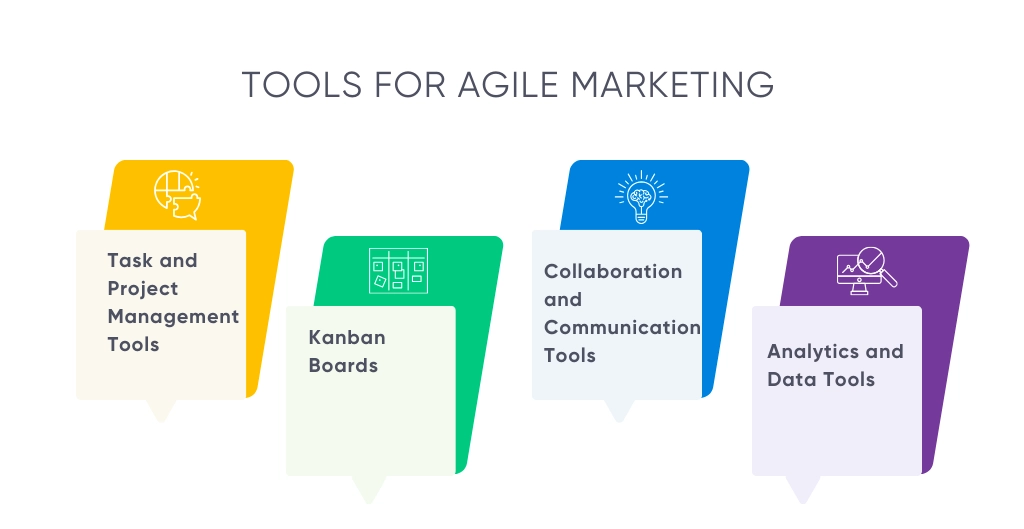
Task and Project Management Tools
Discover popular Agile Marketing tools like Trello, Asana, or JIRA. Learn how these platforms can help you visualize tasks, assign responsibilities, and track progress.
Kanban Boards
Understand the power of Kanban boards in visualizing your marketing workflow, optimizing processes, and ensuring tasks move smoothly from one stage to the next.
Collaboration and Communication Tools
Explore communication tools like Slack or Microsoft Teams to enhance team communication, share updates, and facilitate real-time collaboration.
Analytics and Data Tools
Embrace data-driven decision-making with tools like Google Analytics or HubSpot, allowing you to measure the impact of your marketing efforts and adjust strategies accordingly.
Incorporating Agile Marketing into your organization involves not only adopting Agile methodologies but also fostering a culture of collaboration and investing in the right tools. By building a high-performance team and following Agile practices, you’ll be well on your way to marketing success in the digital age.
8. Final Thoughts: Conclusions and Key Takeaways
As we conclude our exploration of Agile Marketing, it’s essential to reflect on the transformative journey you’re embarking upon. Agile Marketing is not just a methodology. It’s a mindset, a philosophy, and a commitment to continuous improvement. It’s about adapting to change, focusing on the customer, and achieving marketing excellence in an ever-evolving digital landscape.
Embrace Change as Your Ally
In the world of marketing, change is the only constant. Agile Marketing teaches us not to fear change but to embrace it. Change is an opportunity for growth, innovation, and staying ahead of the competition.
By being agile, you can respond to market shifts, emerging technologies, and customer preferences with confidence.
Put the Customer at the Heart of Everything
Agile Marketing is fundamentally customer-centric. It encourages you to listen to your customers, understand their needs, and deliver value that resonates with them.
By prioritizing customer feedback and insights, you can build lasting relationships and brand loyalty.
Collaboration Fuels Success
Agile Marketing thrives on collaboration. Cross-functional teams working together can achieve more than isolated departments.
Breaking down silos and fostering a culture of collaboration can lead to innovative ideas, efficient workflows, and exceptional results.
Data-Driven Decisions
In the Agile Marketing world, data is your compass. Data-driven decision-making enables you to measure the impact of your efforts, adjust your strategies in real-time, and make informed choices.
Embrace marketing analytics as a powerful tool for continuous improvement.
Iterate, Learn, Improve
Agile Marketing is all about iteration. After each sprint or campaign, take time to reflect, learn from your experiences, and apply those lessons to future initiatives. This cycle of continuous improvement is at the core of Agile’s success.
Agile is a journey, not a destination.
Start Your Agile Marketing Journey
Whether you’re just beginning your Agile Marketing adventure or have been practicing it for some time, remember that Agile is a journey, not a destination. There is always room for growth and refinement. Stay curious, stay adaptable, and stay committed to delivering exceptional marketing results.
Join the Agile Marketing Community
Agile Marketing is a dynamic field with a thriving community of professionals eager to share knowledge and experiences. Consider joining Agile Marketing forums, meetups, and online groups to connect with like-minded marketers, ask questions, and collaborate on Agile initiatives.
Your commitment to learning will keep you at the forefront of marketing innovation.
Continuous Learning
Agile Marketing is continually evolving as new tools, techniques, and best practices emerge. Keep learning, attending workshops, and webinars, and reading books and blogs dedicated to Agile Marketing. Your commitment to learning will keep you at the forefront of marketing innovation.
Agile Marketing is not just a methodology. It’s a journey toward marketing excellence, adaptability, and customer-centricity.
As you set sail on your Agile Marketing voyage, remember that the wind of change is at your back, the customer is your guiding star, and collaboration is your compass. With Agile Marketing as your vessel, you’re well-prepared to navigate the ever-changing seas of digital marketing and achieve success beyond your expectations.
Recent Posts
We’ve got something new for you from our expert tutors

Explore the best free AI courses in 2025 on Coursera & Udemy. Learn AI, machine learning, generative AI, and prompt engineering & get certified online


Subscribe to our newsletter
Sign up for our newsletters and digests to get important updates, expert articles, and tips on digital marketing. No spam, essential information only.